
 Back in my college days, I may or may not have purchased a rad t-shirt at Newbury Comics featuring the art of Maurits Cornelis Escher…
One could hardly blame me for being so captivated by the technically beautiful illustrations of stairs and hands as well as the curious perspectival puzzles of M. C. Escher.
Then I met my husband, a big geek and lover of all thing Math & Science, and discovered that amongst other things we shared a love of Escher.
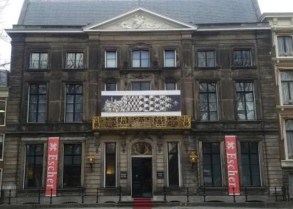
In 2005, while we explored the Netherlands (on a GIRL WITH A PEARL EARRING journey – a blog for another day), we stopped at The Hague to visit the Escher Museum to enjoy some of his “impossible constructions.” It was a great museum, should you be near The Hague – don’t miss it. (I bought a print there of White Angels & Black Devils that sits in my office today.)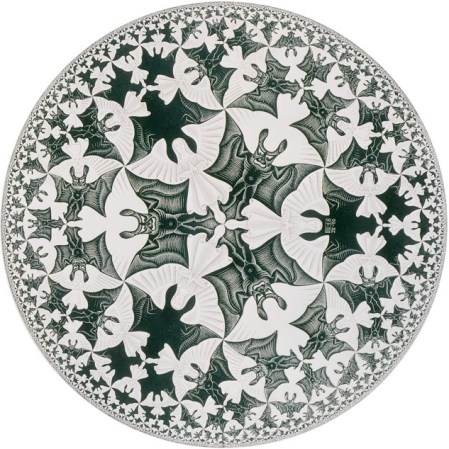 Cut to last month, when my husband read about the current Museum of Fine Arts Boston exhibit: M. C. Escher: Infinite Dimensions (open from February 3, 2018 – May 28, 2018) and asked if I wanted to see it. A trip to a museum – sign me up! I am always game to introduce my boys to a new artist.
 MFA’s M. C. Escher: Infinite Dimensions presents the first exhibition of original prints by the Dutch artist in Boston, bringing together 50 works from public and private collections that highlight his rich imagination and mesmerizing technical ability. (Note: M.C. Escher, during his lifetime, made 448 lithographs, woodcuts and wood engravings and over 2000 drawings and sketches.)
The exhibit was small but well-curated. Escher’s greatest hits were on display:”Hand with Reflecting Sphere,” 1935; “Ascending and Descending,” 1960 as well as “Drawing Hands,” 1948.


I always love when you get a peek into the artist’s process and seeing Escher’s original woodblock and the corresponding woodcut next to it really shed light on the level of detail he was able to achieve. Escher loved to experiment with printmaking – he produced about 450 prints using woodcut, lithography, mezzotint and linocut techniques.


A new found favorite of mine was the 13-foot-long Escher masterpiece entitled: “Metamorphosis II” where tiled creatures change into shape after shape. Leave some time for this beauty as you can really get lost in its rhythm.

One of my favorite things about M. C. Escher: Infinite Dimensions exhibit was the number of families there who were so excited by the work – my boys included. They were mystified by the use of positive and negative shapes to make an entirely different arrangement of forms (known as tessellation.) It was so fun to see families discuss what they saw and share their answer to the puzzle that is Escher.
Escher’s art makes you think and question what you see. This critical thinking component is something my husband and I try to subtly infuse where we can with our children. Being able to do this at an art museum is an incredible opportunity.


Even though Escher’s images are incredibly complex – there is a certain order and sense of calm that they bring. In this uncertain time we live in, who can’t use some calm.
LEARN MORE:
- BIOGRAPHY: http://www.mcescher.com/about/biography/
- VIDEO – ESCHER IS HIS STUDIO: M.C. Escher in his studio while he is making the Eye mezzotint and being interviewed about his life and work. Part of the documentary “Met het oog op avontuur” van Han van Gelder. https://vimeo.com/75384542
- Interesting Paper: Lessons in Duality and Symmetry from M.C. Escher
Abstract: The Dutch graphic artist M.C. Escher (1898-1972) carried out mathematical investigations that led to symmetry drawings of three distinct kinds of tilings with two colors, capturing the essence of duality. He used several of these drawings as key elements in his prints that further expressed ideas of duality. One of the most complex of his “duality” tilings was realized in Delft ceramic tile, wrapped around a large column for a school in Baarn, Holland. Recently, a Salish artist in Victoria, BC, Canada, has independently produced a tiling that contains many of the same elements as Escher’s complex duality tilings.
 restless art syndrome