 On a recent Saturday, my family stopped by the Wadsworth Atheneum, an art museum located in Hartford, Connecticut. Founded in 1842 and opened in 1844, it is the oldest continually operating public art museum in the United States.
The Atheneum is noted for its broad collections that include: European Baroque art, ancient Egyptian and Classical bronzes, French and American Impressionist paintings, Hudson River School landscapes, modernist masterpieces and contemporary works, as well as collections of early American furniture and decorative arts.
The museum has a unique castle-like appearance that made it easy to find. We were surprised to find that admission to the museum was FREE as part of their Second Saturdays For Families.The Atheneum had a wonderful program that day where kids could create their own travel sketchbook and talk to a docent about the adventures of artist Frederic Church.
Here are my top 10 highlights from our Wadsworth Atheneum visit (in no particular order):

I. WARHOL
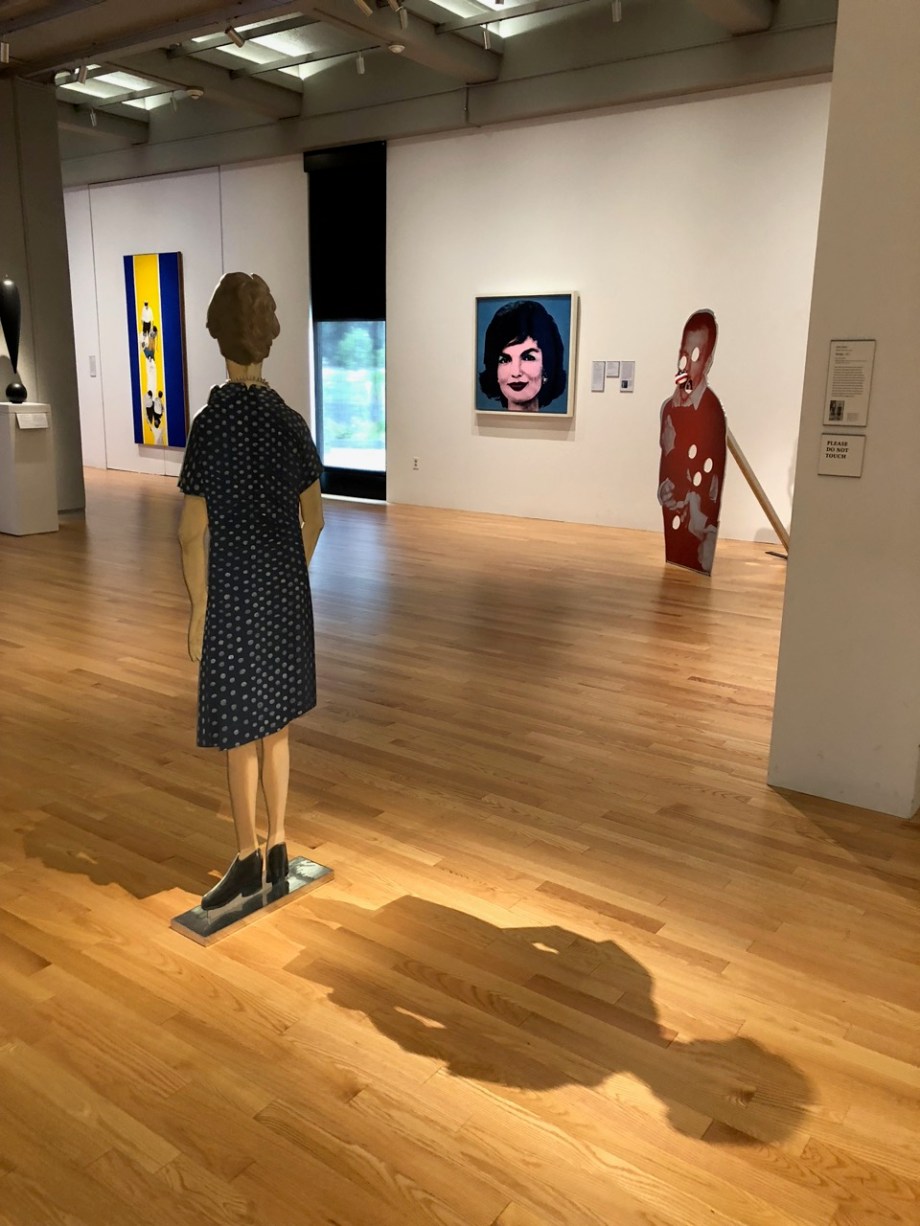
Andy Warhol, Early Colored Jackie, 1964
Warhol’s Jackie, is Silkscreen ink on synthetic polymer paint on canvas, 40 x 40 inches.
Part of their Contemporary Collection, Jackie is amongst the fantastic collection that encompasses works created from 1945 to the present. Of note, this was one of my favorite galleries. Take a look at the curation of the space:
II. CALDER
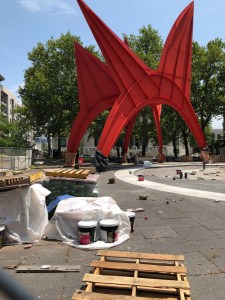
“Stegosaurus” by Alexander Calder, 1973
Although the bright red Stegosaurus was temporarily held captive behind a chain-link fence (as workers install a fountain to flow under the sculpture.) The 50-feet tall Alexander Calder sculpture in Burr Mall, between the Atheneum and City Hall was hard to miss and so much fun to appreciate.
October 10, 1973, Alexander Calder’s sculpture, Stegosaurus, was dedicated in Hartford. Check out this article to learn more.
III. KRASNER
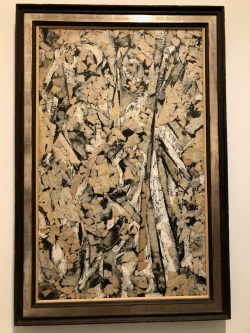
Lee Krasner, Broken Gray, 1955
I am admittedly smitten with Lee Krasner. It has been a long simmering love, that was heightened with my recent purchase of Gail Levin’s Lee Krasner: A Biography. If you are not familiar with her name/work here are some basics – but please check her out.
- Lenore “Lee” Krasner (October 27, 1908 – June 19, 1984) was an American abstract expressionist painter in the second half of the 20th century.
- She is one of the few female artists to have had a retrospective show at the Museum of Modern Art.
- She was married to Jackson Pollock.
- She was an incredible artist and one you should know.


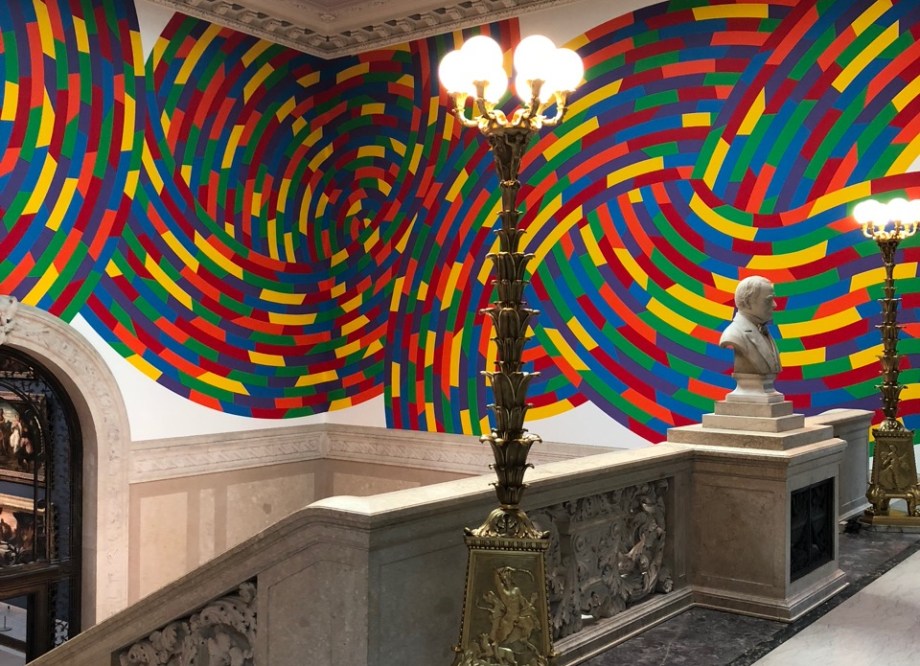
IV. LeWitt
Sol LeWitt, Wall Drawing #793 C., 1996
There was so much to this museum that I sometimes felt like I was at risk of whiplash! Around every corner was something unique and engaging. LeWitt’s Wall Drawing consists of irregular wavy color bands and it dresses up the two facing walls of one of the lobby entrances. The tones of this piece are muted and exquisite.
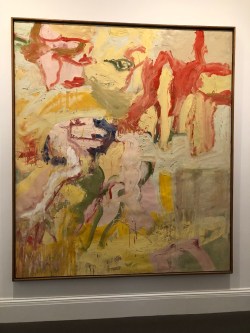
V. de Kooning
Willem De Kooning, Montauk I, 1969
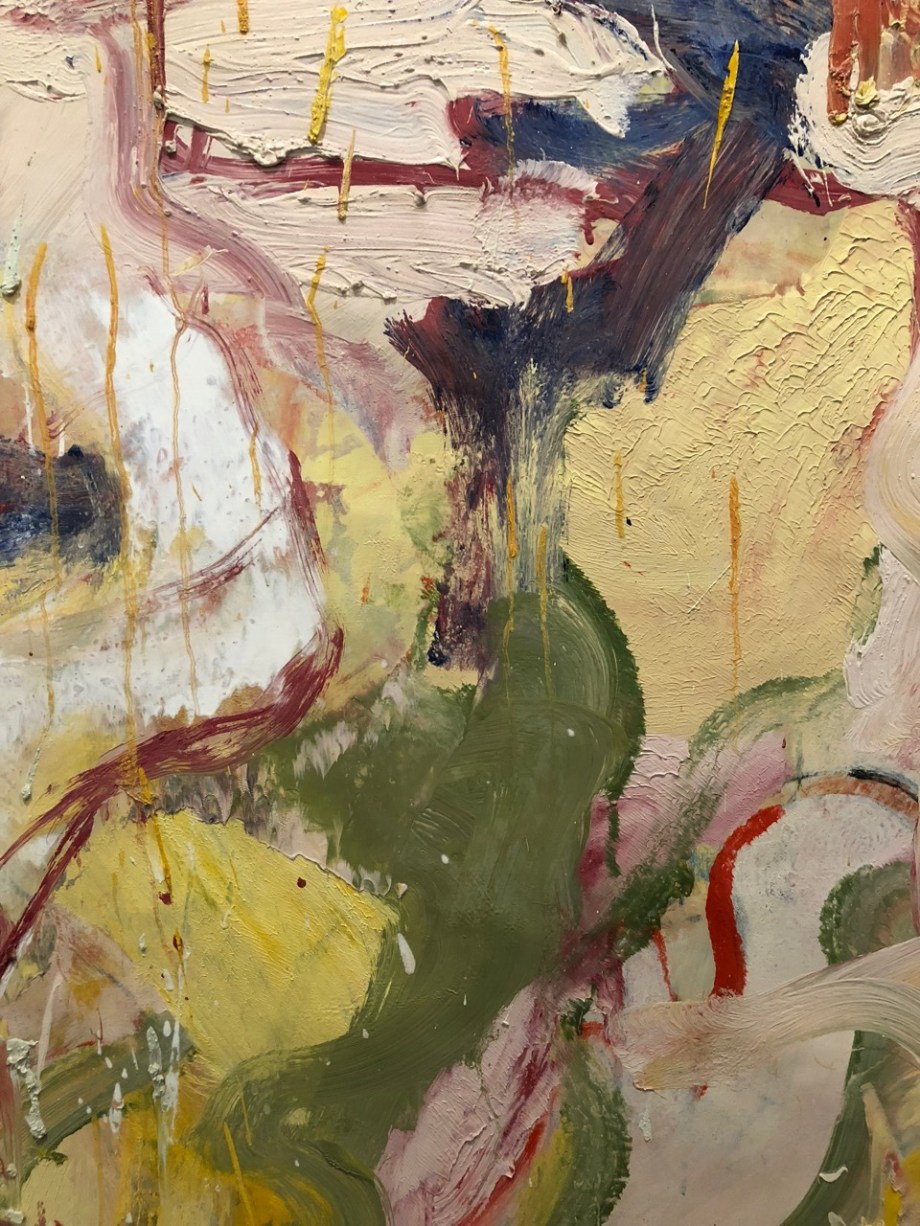
De Kooning was a Dutch abstract expressionist artist. This work captures the artist’s extraordinary capacity for rendering light, landscape, and figural movement in oil paint. His Montauk series richly captures the atmospheric serenity of its eponymous seaside surroundings.
Just look at this detail:
VI. Still
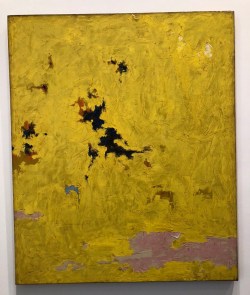
Clyfford Still, Number 5, 1951
I wrote a blog about discovering Clyfford Still during a recent trip to Denver, Colorado. As his works were mostly kept intact in his estate, I was very surprised to find one in the wild as it is rare. I wanted to dig around a bit in the provenance of this piece.
This painting was a Gift of Jane and Tony Smith. So, who was Tony Smith?
Tony Smith was an enigmatic figure, a twentieth-century Renaissance man, an
architect, designer, and sometime poet. His original ambition was to be a painter, and painting was the one medium that he returned to over and over again. However, during the last twenty or so years of his life, from the late 1950s until his death in 1980, he focused primarily on making sculpture, the work for which he is now most celebrated. The 1960s generation acted as if Smith were their discovery, but in truth, during the 1940s and ’50s he was already involved with the art world and friends with most of the leading postwar painters—Barnett Newman, Mark Rothko, Ad Reinhardt, and Clyfford Still — whom he had met in New York.
(Read more here.)
VII. Vincent
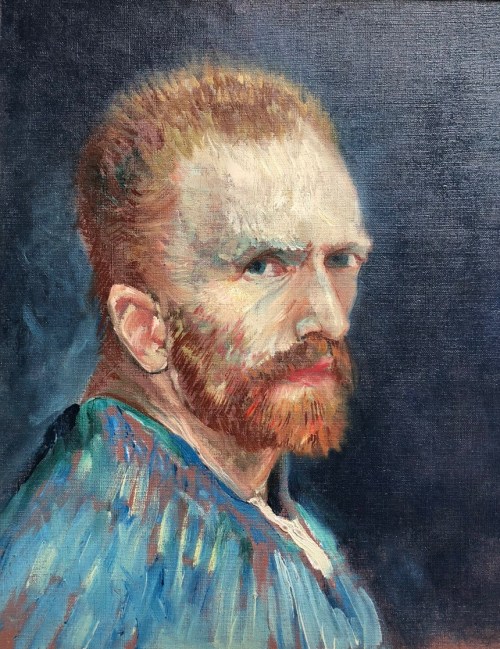
Vincent Van Gogh, Self-Portrait, 1887
Vincent van Gogh painted his first known self-portrait in 1886, following the model of the 17th-century Dutch artist Rembrandt. In this painting the overall blue-green tone of the background serves as a foil to the orange-red of the artist’s hair and beard. Van Gogh painted over 30 self portraits between the years 1886 and 1889 as he often did not have any money to pay for models to paint. His collection of self portraits places him among the most prolific self portraitists of all time. Van Gogh used portrait painting as a method of introspection, a method to make money and a method of developing his skills as an artist.
Provenance:
Purchased by Ambroise Vollard, Paris, June 16, 1896; sold for 8,000 FF in 1913 to John Quinn (d. 1924), New York
VIII. Matisse
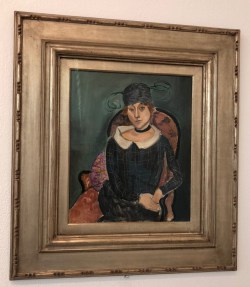
Henri Matisse, The Ostrich-Feather Hat, 1918
This is a painting of Matisse’s beloved daughter, Marguerite. She was a child from a previous relationship Matisse had with a model. She was raised by Matisse and his wife Amélie and often sat as a model for her father.
Back when she was 6, Marguerite had contracted croup or diphtheria. Her breathing became so obstructed that a surgeon was forced to slit open her throat while Matisse held her down on a table. The emergency tracheotomy left her with a three-inch scar that she covered for the rest of her life with a black ribbon.
During the Second World Was she was active in the resistance, but she was arrested by the Gestapo and tortured. She was on her way to the concentration camp in Ravensbrück, but she managed to escape after the train that transported her was halted during a bomb attack by the allied forces.
At the time of her death she had almost finished a monumental catalogue of her father’s works. There was an exhibit in Baltimore that focused on Matisse’s “Marguerite” works.
IX. Hofmann
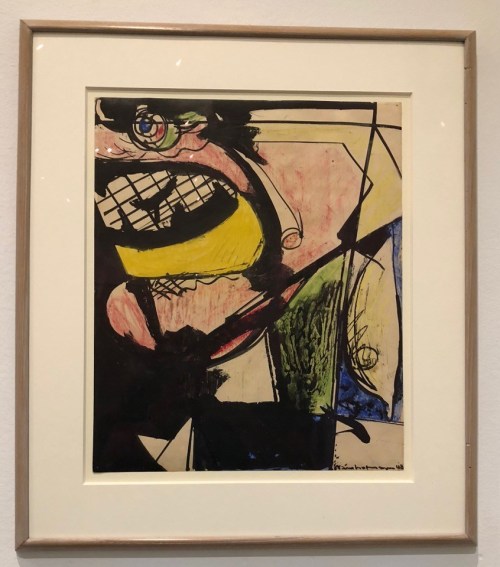
Hans Hofmann, Untitled, 1948
Hans Hoffmann’s Abstract Expressionist paintings are amazing. This was an unusual work on paper – it consisted of black ink and colored crayon on wove paper.
Art is to me the glorification of the human spirit, and as such it is the cultural documentation of the time in which it is produced.
– Hans Hofmann
Curatorial Narrative: “Untitled” depicts a Cubist-inspired still life, its most basic elements abstracted and flattened to color, form, texture, and line. The solid yellow form suggests a banana, round elements evoke fruit, and a curved shape implies a bowl. Hofmann was a leader of the Abstract Expressionist movement, which values emotional intensity and features nonrepresentational subject matter. He was well known for the development of the “push-pull” effect in abstract painting, in which color seems to advance or recede from the canvas creating the illusion of movement and depth.


X. Current Exhibit: Frederic Church: A Painter’s Pilgrimage
June 2 – August 26, 2018
My family fell in love with the luminous quality of Frederic Church during a visit to the Currier Museum (Manchester, NH) last winter. We all were captivated by South American Landscape.
It was sheer luck that we were able to see this exhibit. It touts: From ancient ruins to awe-inspiring landscapes, experience the world’s beauty through the eyes of 19th-century painter, Frederic Church.
It does not disappoint.
Two other facts about the Wadsworth Atheneum:
- MATRIX
MATRIX, a changing series of contemporary art exhibitions, was initially funded in 1974 as an experimental pilot project with a grant from the National Endowment for the Arts. Since its first exhibition in January 1975, MATRIX has shown over 1,000 works of art by more than 160 artists including: Cindy Sherman, Sol Lewitt, and Ellsworth Kelly. Half of the artists have been in their 30s or younger, and more than one-third did not have an affiliation with a commercial gallery at the time of their MATRIX experience. - The Amistad Center
Founded in 1987, The Amistad Center for Art & Culture is a not-for-profit cultural arts organization that owns a vital collection of 7,000 items including art, artifacts, and popular culture objects that document the experience, expressions, and history of people of African American heritage.
It is well worth the trip to Hartford to explore this historic museum. Enjoy and let me know what your highlights are when you go.

 restless art syndrome